 Skip to content


What is Inox Steel and What Does “Inox” Mean?
If you’ve ever shopped for high-end kitchen appliances, browsed for marine hardware, or admired modern
architectural fixtures, you’ve almost certainly encountered the term “Inox.” You may
have seen it stamped on a premium watch, a kitchen sink, or a structural railing. But what exactly
is material Inox? Is it a specific brand, a special type of coating, or something else entirely?
The simplest answer is also the most direct: “Inox” is just another name for stainless
steel.
The term “Inox” is a shortened form of the French word inoxydable. When broken down, the
etymology is simple: “in-“ means “non” and “oxydable” means “oxidizable” (or “rusting”).
Therefore, the inoxydable meaning is literally “non-oxidizing” or “a material
that does not rust easily.” This elegant term was adopted globally as a common name for
stainless steel, especially in European and technical contexts.
So, when you see a product labeled as “inox steel” or “inox stainless steel,” you are simply looking at a
product made from standard stainless steel. The name itself emphasizes the material’s most
important and valued property: its remarkable ability to resist corrosion and rust.
What Makes Inox Material Special? The Magic of Chromium
The secret to inoxidable steel’s resilience lies in its chemical composition. All steel is
fundamentally an alloy (a mixture of metals) of iron and carbon. What transforms regular steel
into stainless steel (Inox) is the addition of a significant amount of the element
chromium.
By definition, any Inox material must contain a minimum of 10.5% chromium by mass.
This chromium is the “magic ingredient” that gives the steel its “stainless” properties. But how
does it work?
Understanding the “Passive Layer”: Steel That Heals Itself
The protection offered by chromium is not a coating; it’s an active, integral part of the steel itself.
When the chromium in the alloy is exposed to oxygen (even just the oxygen in the air), it undergoes a
chemical reaction. It forms a very thin, stable, and invisible layer on the metal’s surface
called a “passive layer” or “chromium oxide layer.”
This passive layer acts as a durable, non-porous shield, instantly sealing the vulnerable iron in the
steel from the environment (like water and air). This is what prevents rust and corrosion from
forming.
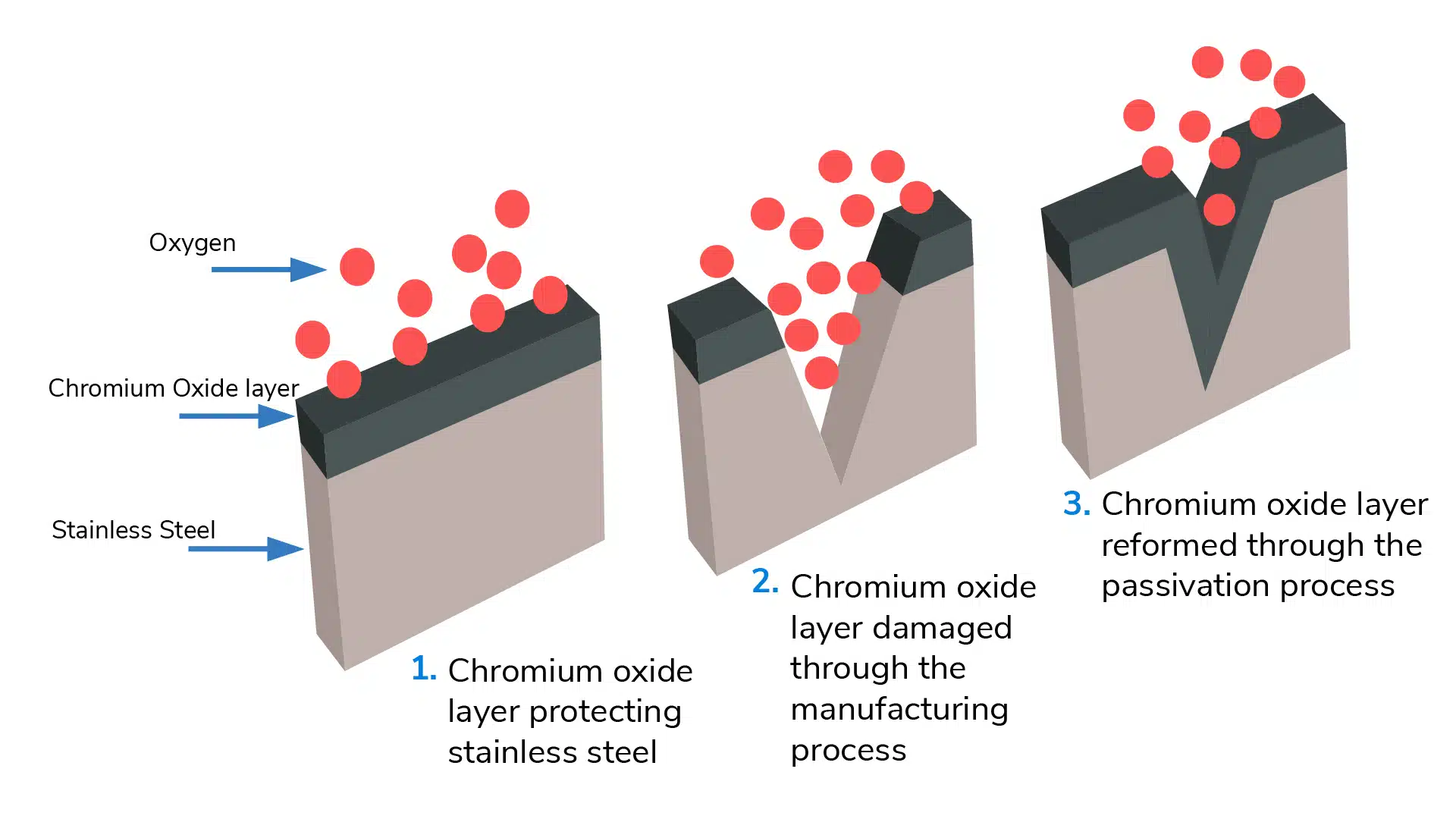
[A diagram here showing how the chromium oxide passive layer forms would be very helpful to
visualize this concept.]
What makes this material Inox truly incredible is that this shield is self-healing.
If the surface is scratched, cut, or damaged, the newly exposed chromium in the steel
immediately reacts with oxygen and reforms the protective passive layer, sealing the damage before rust
can ever begin. This is a key difference from coated materials like painted or galvanized
steel, where a scratch exposes the base metal to permanent corrosion.
Is All Inox Steel the Same? Exploring the Grades
No. “Inox steel” is a broad term that covers several different families and hundreds of specific grades.
While all are defined by their chromium content, different alloying elements—like
nickel, molybdenum, and manganese – are added to fine-tune properties for strength,
hardness, magnetism, and specific types of corrosion resistance.
The grades are primarily grouped into four main families:
1. Austenitic (The Workhorses: 300 & 200 Series)
This is the most common and widely recognized family of Inox stainless steel. They are known for
their excellent formability (easy to bend and shape), superior corrosion resistance, and are
non-magnetic.
Inox Grade 304 (18/8)
This is the most popular grade of Inox steel worldwide. It typically contains 18% chromium and 8%
nickel, which is why it’s often called 18/8 stainless steel. Grade 304 offers
excellent corrosion resistance in most environments, making it the standard for kitchen appliances, food
processing equipment, sinks, cutlery, and general architectural trim.
Inox Grade 316 (Marine Grade)
This is the superior choice for harsh environments, especially coastal areas with salt in the air.
Grade 316 contains the same 18% chromium as 304, but it adds about 2-3% of another element:
molybdenum. This molybdenum significantly enhances its resistance to
chlorides – specifically, salt. This addition makes 316 the essential choice
for boat fittings, coastal railings, and any application constantly exposed to salt spray.
2. Ferritic (The Magnetic Group: 400 Series)
This family of Inox (including Grade 430) has a different crystal structure, which
means it is magnetic. While it doesn’t have the same high-level corrosion
resistance as the 300 series, it’s still highly resistant to oxidation and is very cost-effective (it
lacks the expensive nickel). It’s common in applications like automotive exhaust systems,
indoor decorative trim, and some refrigerator doors (where magnets need to stick).
3. Martensitic (The Hard & Strong Group: 400 Series)
Also part of the 400 series (like Grades 410 and 420), martensitic grades are known for
their exceptional strength and hardness, which is achieved through heat treatment.
This hardness, however, comes at the expense of some corrosion resistance compared to
austenitic grades. You’ll find martensitic Inox steel used for high-wear items like
professional knives, surgical instruments, and industrial valves.
4. Duplex (The High-Performance Hybrid)
As the name suggests, Duplex stainless steels (like Grade 2205) have a mixed microstructure
of both austenite and ferrite. This hybrid structure gives them a “best of both worlds”
profile: they have a much higher strength (often twice as strong as 300 series grades) and superior
resistance to chloride stress corrosion cracking. For critical infrastructure in harsh
environments, like chemical plants or bridges exposed to saltwater, Duplex grades are an increasingly
popular, high-performance solution.
Inox Families at a Glance: Comparison Table
Here is a simple table to help you compare the main families of Inox stainless steel:
| Inox Family | Common Grades | Key Properties | Common Applications |
|---|---|---|---|
| Austenitic | 304, 316 | Non-magnetic, excellent corrosion resistance, highly formable. | Boat railings (316), outdoor kitchens (304), architectural trim. |
| Ferritic | 430 | Magnetic, good corrosion resistance, cost-effective. | Indoor appliances, automotive exhaust, interior decorative trim. |
| Martensitic | 410, 420 | Magnetic, very hard and strong, moderate corrosion resistance. | High-end knives, surgical instruments, industrial valves. |
| Duplex | 2205 | Magnetic, 2x stronger than 300 series, extreme corrosion resistance. | Critical marine hardware, chemical plants, bridges in saltwater zones. |
Table data adapted from source.
Inox vs. Other Metals: A Quick Comparison
How does Inox steel stack up against other common metals?
- Inox vs. Aluminum: Aluminum is fantastic for being lightweight and is also highly
corrosion-resistant. However, Inox is significantly stronger, harder, and more
resistant to scratches and dents. This makes Inox more durable for high-traffic
applications like countertops, railings, or industrial equipment. - Inox vs. Carbon Steel: Regular carbon steel (or “mild steel”) is very strong and
less expensive, but it has one major, defining flaw: it rusts easily.
Carbon steel *requires* a protective coating like paint or galvanizing. Inox is chosen when the
strength of steel is needed, but the project demands long-term, built-in corrosion resistance that
carbon steel cannot provide on its own.
Where is Inox Steel Used? Key Applications
Because of its clean, modern look and its incredible resilience, Inox material is a top choice for
projects, especially in regions where humidity, sun, and salt are constant challenges.
- Marine and Coastal: This is where Inox truly shines. Grade 316 Inox
is the non-negotiable standard for boat railings, cleats, anchors, and any hardware constantly
exposed to saltwater. Its ability to resist pitting and corrosion is essential for safety
and longevity on the water. - Architecture and Construction: Look at the balconies, railings, and window frames of
modern buildings. That clean, bright, and rust-free finish is almost always Inox steel.
It provides structural strength while withstanding salt in the air, requiring far less
maintenance than painted carbon steel. - Outdoor Kitchens and Entertainment: Inox is the preferred material for high-end
outdoor kitchens, grills, cabinets, and countertops. It can handle intense sun without
fading, withstand rain without rusting, and is hygienic and easy to clean after a
barbecue. - Food & Beverage Industry (and Medical): From commercial kitchens to breweries, Inox
steel is used for sinks, prep tables, and tanks. Its non-porous surface
doesn’t harbor bacteria, is easy to sanitize, and won’t react with acidic foods, ensuring purity and
safety. This is the same reason it’s essential for medical and surgical instruments.
Conclusion: Why Inox is a Smart Investment
So, what is Inox steel? It is the proven, reliable, and beautiful material we all know as stainless steel.
The meaning of Inox is a direct promise of its performance: it is a material engineered to
resist oxidation and rust, providing a lifetime of service and style.
Whether you are fabricating a high-end architectural feature, outfitting a yacht, or building the ultimate
outdoor kitchen, choosing a high-quality material Inox – and the *correct grade* like 304 or 316 – is a
smart investment in your project’s longevity and future.
Contact
Contact C & R Metals today for expert advice and premium metal supply in South Florida. Call (305) 634-2111 or email sales@crmetals.net
to speak with our team about your project needs. Visit us at 2991 NW North River Dr., Miami, FL, 33142.
We’re open Monday to Friday from 7:30 AM to 4:30 PM, and Saturday from 8:00 AM to 1:00 PM. Closed on Sunday.
Proudly serving Miami-Dade County, Broward County, Monroe County, and Palm Beach County.